Cornea
Rethinking Aberrations: Gatinel–Malet Decomposition
In this second part of a three-part series, two experts delve into Gatinel–Malet decomposition.

Soosan Jacob
Published: Wednesday, July 1, 2026
SJ: In part one, we discussed that some higher orders ‘borrow’ lower shapes. Why does this happen?
DG: Maintaining orthogonality means ensuring two distinct Zernike polynomials have a net product of zero when integrated over a circular pupil. Therefore, each basis mode is mathematically independent of the others, and changing the coefficient of one mode does not alter others.
A pure higher-order shape (like a sharp outer edge) naturally introduces central slopes. These central slopes mathematically mimic lower-order shapes, such as defocus or tilt. To keep the net product at zero against those lower modes, the higher-order polynomial must include a ‘counterweight.’ It adds a negative version of the lower-order shape into its own formula to balance the equation to zero. Thus, though the Zernike fit is mathematically correct, the higher-order coefficients appear deceptively small as descriptors of pure higher-order aberration (HOA) content.
When we actually examine the structure of these modes, what do we find?
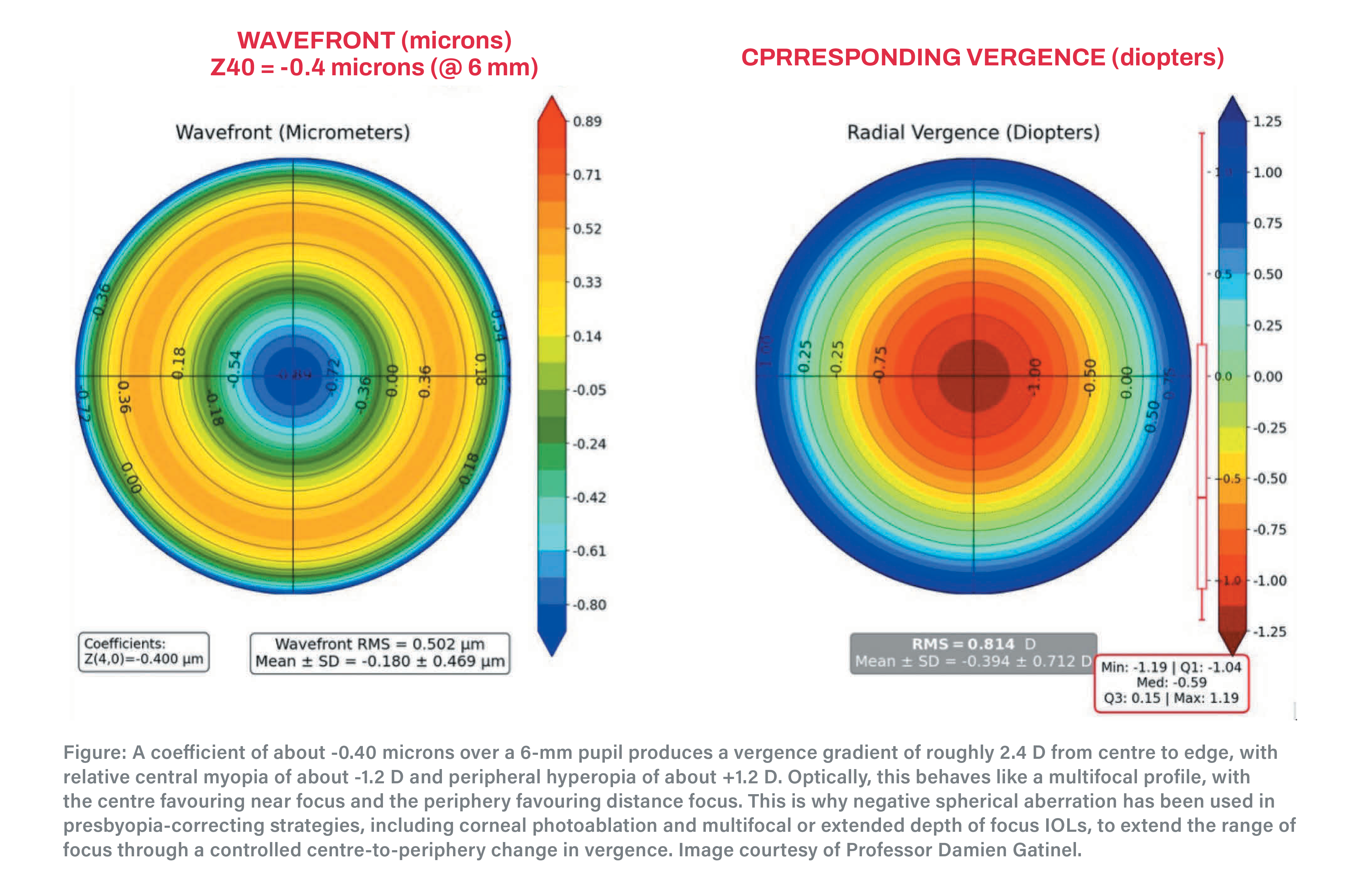
We see the problem is visible in the modes. Because classic Zernike spherical aberration (Z40) is labelled as a fourth-order aberration, one might expect it to behave like a clean quartic profile, a pure (r4) shape that is relatively neutral centrally. However, in its central part, it behaves more like defocus, carrying a distinctly low-order signature near the pupil centre. The embedded quadratic defocus-like component at the centre is far from negligible. From a refractive point of view, it can outweigh genuine fourth-order part. Thus, what we call a ‘higher-order mode’ may exert much stronger low-order influence than its name suggests. Similarly, secondary astigmatism, an HOA, contains a cylindrical component resembling ordinary astigmatism and coma includes the linear component, tilt.
So clinically, these are not optically pure. Although mathematically assigned as HOA, structurally they contain hidden low-degree behaviour. Therefore, its coefficient no longer represents purely higher-order optical deformation but instead a mixture, making interpretation much less intuitive.
Is what you call the ‘true’ quartic part essentially the old Seidel representation? Is the Gatinel–Malet approach simply returning to Seidel aberrations?
Not exactly, but there is a meaningful connection. The classical Seidel spherical aberration is a pure quartic term, proportional to r4, whereas the usual Zernike spherical aberration mode is a balanced polynomial that contains not only an r4 term but also a quadratic r2 defocus component. That defocus is introduced so the Zernike mode remains orthogonal to the defocus mode over the pupil. From a mathematical point of view, it is elegant. From a clinical point of view, it can be misleading because a mode that is labelled ‘higher order’ is no longer refractively neutral.
The low-degree/high-degree (LD/HD) approach is not simply Seidel theory revived. Its purpose is different. Seidel aberrations belong to classical optical aberration theory, whereas the LD/HD decomposition is a new polynomial basis designed for clinical wavefront interpretation. But the LD/HD philosophy does move closer to the Seidel intuition in one important respect: it tries to ensure that a higher-order term behaves like a genuinely higher-order term, without hidden low-degree content. In that sense, it restores a kind of optical purity that is lost in the standard Zernike representation.
Is that the main reason the wavefront needed to be reorganised?
Precisely. Zernike polynomials are not mathematically wrong—they are elegant, powerful, and very useful. But the problem is their orthogonality does not provide the separation clinicians need. In ophthalmology, a low-degree component should represent wavefront curvature that determines sphero-cylindrical refraction, while a high-degree component should represent true residual deformations that affect image quality beyond ordinary refraction. In the standard Zernike system, that boundary is blurred: refraction leaks into HOA side, and HOA content in turn alters the apparent refractive side. That is why a different organisation is needed.
So how does the Gatinel–Malet LD/HD decomposition deal with this?
It is straightforward. The wavefront is reorganised into two deliberately defined components: (a) the low-degree component that determines ordinary refraction, which includes everything up to degree two (piston, tilt, defocus, and primary astigmatism) and (b) the high-degree component, which includes only terms of degree three and above (coma, trefoil, spherical aberration, secondary astigmatism, and the other genuine HOAs).
This is not just relabelling. It is designed to keep all quadratic behaviour in LD and therefore to correspond to true spectacle-correctable refractive component. Similarly, the high-degree side is purified of hidden low-order contamination.
But mathematically, there is a trade-off?
Yes, and that is the key trade-off. To achieve a clinically clean separation, we deliberately give up global orthogonality between LD and HD. In return, we gain a more useful clinical orthogonality: LD becomes a watertight representation of refraction while HD is purified of hidden low-order terms. Importantly, orthogonality is still preserved within each group. Low-degree modes remain orthogonal to one another, and high-degree modes remain mutually orthogonal, so HOA root mean square (RMS) can still be calculated reliably to compare aberrations.
What difference does this make when we interpret the coefficients?
It makes an important difference. In the classical Zernike basis, higher-order coefficients can appear deceptively small because part of their optical effect is represented by low-order coefficients to preserve global orthogonality. In the LD/HD framework, that hidden mixing is removed, so the HD coefficients more faithfully reflect the true contribution of each HOA to the wavefront. That, in turn, makes derived measures of image quality such as the point spread function, convolution-based simulated retinal images, and modulation transfer function curves more clinically meaningful and easier to reconcile with the patient’s visual experience.
How should we picture the LD/HD basis in practical terms?
A useful way to think of it is as two distinct spaces. The low-degree space contains the spectacle-correctable terms—piston, tilt, defocus, and primary astigmatism—that define the eye’s overall refractive behaviour. The high-degree space, beginning from degree three, contains purified higher-order modes that no longer carry hidden tilt or defocus. They are built to remain as neutral as possible near the centre and therefore better represent the true residual optical imperfections affecting image quality that cannot be neutralised by ordinary sphero-cylindrical correction. This is done while keeping the HD modes mutually orthogonal.
The practical rule is simple: Keep all refraction-defining quadratic content in LD, with no r2 leakage into HD. Then read sphere and astigmatism from LD, and reserve HD for genuine higher-order aberrations.
That is the essence of the Gatinel–Malet separation: low-order modes are normalised and orthogonal as are the now pure high-order modes. However, there is no orthogonality between low-order and high-order modes. Therefore, refractive side and image quality-degrading side are no longer contaminating each other.
Part one of this interview appeared in the March/April 2026 edition of EuroTimes.
Soosan Jacob MS, FRCS, DNB is Director and Chief of Dr Agarwal’s Refractive and Cornea Foundation at Dr Agarwal’s Eye Hospital, Chennai, India, and can be reached at dr_soosanj@hotmail.com.
Damien Gatinel MD, PhD, is Head of the Anterior and Refractive Surgery Department, Rothschild Foundation, Paris, France.