Sponsored Content, Cataract, Refractive, IOL
Innovating the Next Generation of IOL Performance Across the Full Continuum of Care

As surgeons navigate expanding IOL choice and rising patient expectations, Alcon’s next-generation Clareon® portfolio is advancing performance across Full Range of Field, EDOF and enhanced monofocal categories to create the best possible quality of vision for each patient need.
A New Era in IOL Decision-Making
Cataract surgery has evolved beyond restoring vision. As intraocular lens (IOL) technologies expand, surgeons are increasingly asked to optimize visual performance for the individual patient—balancing range of vision, image quality, visual comfort and confidence in realworld conditions.
Against this backdrop, Alcon is introducing the next generation of its Clareon® IOL portfolio, including Clareon® PanOptix® Pro and Clareon® TruPlus™. Building on its legacy as the global leader in IOL innovation, Alcon can now push further by addressing physical limitations and existing trade-offs of the IOL selection process.
Pushing the Boundaries and Reducing Traditional Trade-Offs
Across the continuum, surgeons balance range, distance quality, contrast, visual comfort, tolerance for visual phenomena, and consistency across lighting conditions.
The next frontier is not more IOL choices but shifting the trade-off curve within the categories surgeons already rely on. Advances in optical design are elevating expectations within each category, improving quality of vision while mitigating traditional compromises.
For monofocal IOLs, the trade-off centers on range. Traditional monofocals provide limited functional range, while enhanced monofocals aim to extend it, although some lens designs have reported differences in distance visual performance versus conventional monofocals.5 The opportunity is to extend useful range while preserving the distance-first visual quality and predictability surgeons expect from this category.6,7
Extended Depth of Focus (EDOF) technologies face a different boundary. Recent non-diffractive designs have extended depth of focus while preserving visual comfort, but near vision and spectacle independence remain limitations of the category.8,9 For EDOF, the next-generation challenge is how much the category can move closer to functional near while maintaining distance and intermediate quality, contrast and low visual-disturbance profile.
Trifocal/Full Range of Field (FROF) IOLs address the other end of the continuum, where range and spectacle independence are prioritized.10,11 For this category, progress depends on improving how light is managed across the full range of vision, with the goal of reducing visual disturbances and scatter while improving the quality, contrast and comfort patients need.12
By addressing these trade-offs across the IOL continuum, the next generation of Alcon IOLs are allowing patients greater opportunity for higher quality vision and more functional range, regardless of category.
The Science Behind Next-Generation IOLs
Pushing the boundaries of IOL performance depends on the convergence of three components: material science, manufacturing precision and optical design. Together they help explain how Alcon is reducing trade-offs in its next generation IOLs.
Across the Clareon® platform, Alcon’s advanced hydrophobic acrylic material and high refractive index support optimized optical structures and a more than 49% larger usable optic surface versus TECNIS^, helping direct more light through the intended optical zone.13-15 Compared with lower-refractive-index materials, including TECNIS, Clareon®’s material enables a fully usable 6 mm optic designed to support high image quality, lower sensitivity to pupil size and lighting conditions, and a lower halo and glare profile versus TECNIS Eyhance, based on bench data.5,16
| Spherical Dioptric Power | ||
|---|---|---|
| Power Range | Industry Tolerance22 | Clareon® Tolerance22 |
| 0 to 15 D | ±0.30 D | ±0.25 D |
| 15 to 25 D | ±0.40 D | ±0.25 D |
| 25 to 30 D | ±0.50 D | ±0.25 D |
| Greater than 30 D | ±1.00 D | ±0.50 D |
| Cylinder Dioptric Power (Toric) | ||
| 0 to 2.5 D | ±0.30 D | ±0.25 D |
| 2.5 to 4.5 D | ±0.40 D | ±0.25 D |
| Greater than 4.5 D | ±0.50 D | ±0.25 D |
The second component is manufacturing. Advanced Clareon® manufacturing translates optical concepts into highly precise, reproducible lens designs, including targeted refinements at the sub-micron level. Alcon’s manufacturing allows for even less than 0.5-micron adjustments in step heights, while structured process controls, expert human oversight and extensive validation, including at least 41 inspections depending on model, help support consistency from lens to lens.17,‡
The third component is optical design. Each next-generation Clareon® IOL reflects an extensive design process in which multiple optical models are developed, tested and screened before a final design is selected. As stated by Alcon’s R&D Vice-President, Rob Scott, “Every new Clareon® IOL begins with a clear objective: deliver better visual outcomes for patients. Using advanced optical modeling, we evaluate hundreds of potential designs before narrowing them to the most promising candidates. Through rapid prototyping, extensive testing, and human vision simulation studies, we iteratively refine each design until we identify the solution with the greatest potential to improve real-world patient outcomes.”
Advancing the Full Range of Field Category
For FROF IOLs, the defining challenge is continuity across the full range of vision and limiting visual disturbances. PanOptix® has already set the bar for continuous near-to-far vision, but visual disturbances remain a necessary consideration for the category when compared to EDOF or monofocal approaches.10-12
Clareon® PanOptix® Pro addresses this with ENLIGHTEN™ NXT Optical Technology, designed to optimize the PanOptix® diffractive profile for uninterrupted light distribution across the full range and the lowest level of light scatter among trifocal IOLs. PanOptix® Pro is also designed for better image contrast and harnesses 94% of total light energy compared with 88% for Clareon® PanOptix®.17,18,‡,§
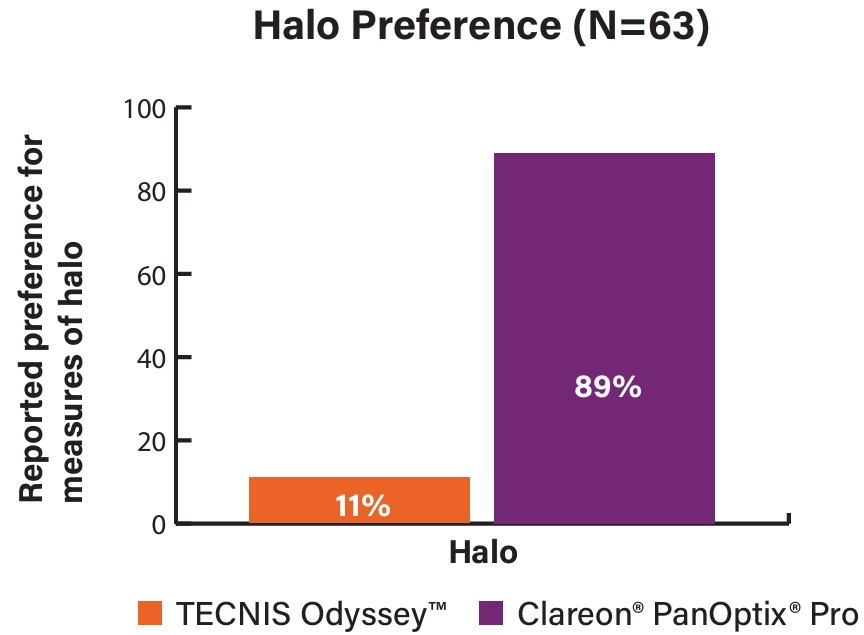
Those optical refinements are reinforced by bench evidence demonstrating a 16% higher MTF image quality compared with Clareon® PanOptix® at -1D, supporting image quality and contrast in the far-intermediate range.17,‡ The benefits also extend to direct simulated comparisons with TECNIS^ Odyssey^: in simulated studies of 65 healthy phakic volunteers, more subjects reported a preference for PanOptix® Pro over Odyssey for measures of starburst and halo and for simulated intermediate vision. PanOptix® Pro subjects also reported higher simulated monocular intermediate VA than Odyssey.19,Δ,¶,Ω,**,††
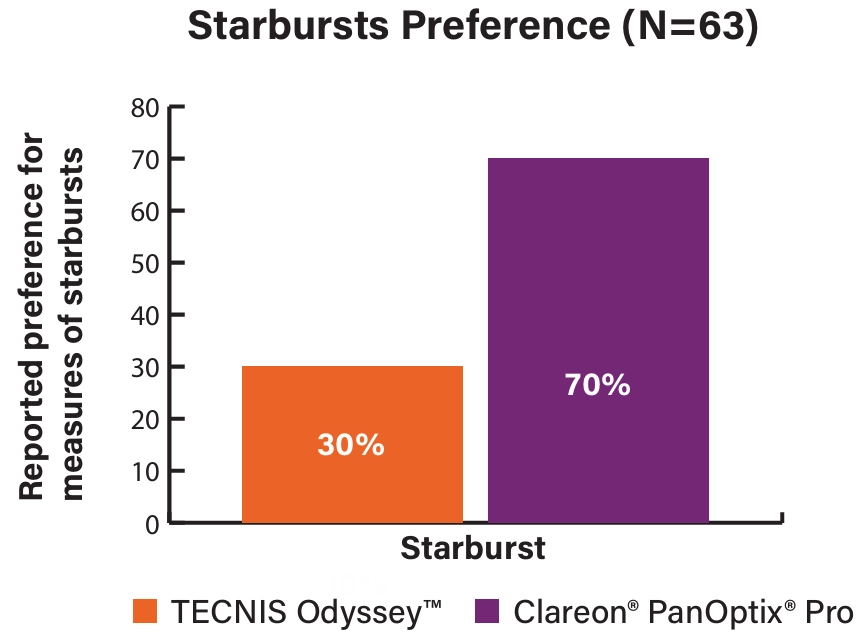
Clinical data presented at ASCRS 2026 suggests these optical refinements preserve the expected 20/20 vision across the full-range while pointing toward quality-of-vision benefits.20,‡,§§ Specifically, Zavodni, Solomon et al. found that at six months, PanOptix® Pro showed numerically higher rates of patients achieving 20/25 or better vision at 4 m, 66 cm, and 120 cm, with comparable performance at 40 cm. It also showed preference trends favoring PanOptix® Pro for low-light halos and starbursts and photopic high-contrast vision at 4 m and 120 cm.21
“PanOptix® Pro is a thoughtful technological evolution of PanOptix®,” said Dr Francesco Carones. “The focus on light management, improving optical efficiency and reducing scatter, while preserving the full range of vision surgeons expect from PanOptix®, gives me greater confidence about recommending it to a broader range of patients compared to alternatives.”
Shaping the Next-Generation Non-Diffractive EDOF
Beyond FROF, EDOF lenses like Clareon® Vivity® have become an important option because they can deliver distance and intermediate quality with a low visual disturbance profile, but the next challenge is to elevate performance further so that more patients can experience high-quality vision across a broader range of real-world conditions.8,9,22-24,¶ Next-generation EDOFs should push the category beyond today’s boundaries, moving closer to functional near while preserving the distance and intermediate quality, contrast and visual comfort surgeons value.8
Elevating the Enhanced Monofocal Category
For patients who are not opting for a PCIOL, enhanced monofocal IOLs can provide a modest extension in functional range.6,7 The tradeoff is that some current designs, distance image quality may be more sensitive to pupil size, lighting conditions and lens position, potentially affecting distance image quality.5-7 Clareon® TruPlus™ is designed to address this need by slightly extending depth of focus while maintaining the distance performance expected from a monofocal.6,7,26
In bench MTF testing, Clareon® TruPlus™ demonstrated enhanced intermediate performance versus Clareon® Monofocal, without compromising the quality of distance vision surgeons expect from monofocal IOLs.6,7
At the design level, TruPlus™’s Opti-Balance™ Technology reflects a next-generation approach to optimizing visual performance by balancing range and quality while maintaining the Clareon® platform’s -0.2 microns spherical aberration.25 Built on the Clareon material and platform, TruPlus™ is designed to support predictable, high-quality distance and intermediate vision across pupil sizes.6,7,26
A fully usable 6 mm optic is designed to support high image quality and lower halo and glare profile versus TECNIS^ Eyhance^.5,6 In bench testing, TruPlus™ demonstrated higher distance image quality across pupil sizes and lighting conditions versus TECNIS Eyhance.5 Additionally, Eyhance’s small central optic and more pronounced edge profile demonstrated increased susceptibility to dysphotopsia when decentered.16
“Patients who choose a monofocal IOL are typically prioritizing distance vision, but many would still welcome a slight extension of functional range.” said Dr Morgan Micheletti. “The bench data and my early experience with Clareon® TruPlus™ have been encouraging, and part of what I value is that TruPlus™ builds on the broader Clareon® platform, including the fully usable 6 mm optic shared across the portfolio. Compared with a 4.9 mm zone, the 6 mm optic provides nearly 50% more usable refracting area to focus incoming light onto the retina.”
Pushing The Limits of Technology for The Benefit of Patients
The practical significance is not simply more options, but clearer choices, helping surgeons match the right optical design to the right patient while preserving visual quality, consistency, and confidence.
The Clareon® portfolio creates a patient-centered continuum based on visual needs, tolerance for visual phenomena, ocular profile, and lifestyle demands.
Within that framework, PanOptix® Pro advances the FROF category through less light scatter while TruPlus™ is designed to bring intermediate vision with no compromise on distance image quality.6,7,17,18,26,§
Designing the Future of Real-World Vision
Alcon’s leadership helped pioneer the current era of IOL technology by pushing the limits of optical design, material science, and manufacturing. Today, the future of IOL innovation lies not in a one-size-fits-all lens, but in a portfolio that better addresses diverse patient needs and expectations. Alcon’s next-generation Clareon® portfolio reflects this shift, setting a new bar for what’s possible in cataract refractive surgery.
Alcon medical device(s) comply with the current legislation for the medical devices. Please refer to relevant product’s instructions for use for complete list of indications, contraindications, warnings and serious incidents. Please find at: https://ifu.alcon.com/
Some product(s) availability with your local sales representative.
^Trademarks are the property of their respective owners.
*Based on worldwide unit sales of AcrySof IQ Vivity and Clareon Vivity IOLs, as of Q4, 2024.
†Based on worldwide IOL unit sales, Q1-Q3, 2023.
‡Compared to Clareon PanOptix
§Compared to Clareon PanOptix. PanOptix has 88% light utilization (12% scatter light)/PanOptix Pro 94% light utilization (6% scatter light).
¶ Visual disturbance assessment through a visual simulation in phakic patients. Assessor masked to IOLs.
Δ Subjects were presented a night scene set at 4m and viewing LEDs and asked to say which IOL they prefer for 1) Starburst and 2) Halo
ΩBased on a Monocular defocus curve in a virtual simulation with phakic patients & subjective preference of IOL at intermediate defocus when viewing 0.2 logMAR. Assessor masked to IOLs.
**Question: Which IOL do you prefer viewing the 0.2 logMAR line at intermediate distance?
††Based on a Monocular defocus curve in a virtual simulation with phakic patients. Assessor masked to IOLs.
‡‡Based on mean value of binocular defocus curve at near, intermediate, and distance at 6 months (n=127
§§Snellen VA was converted from logMAR VA. A Snellen notation of 20/20-2 or better indicates a logMAR VA of 0.04 or better, which means 3 or more of the 5 Early Treatment Diabetic Retinopathy Study chart letters in the line were identified correctly.
¶¶ Results from a prospective, randomized, parallel group, subject- and assessor-masked, multisite trial of 107 subjects bilaterally implanted with the AcrySof IQ Vivity Extended Vision IOL and 113 with the AcrySof IQ IOL with 6 months’ follow-up.
© 2026 Alcon Inc. 08/26 IMG-CPO-2600022
Scan or click for references