Cataract, Refractive, IOL, Artificial Intelligence
New AI-Powered Biometry Scanner App
Clinicians can expect quick and efficient preoperative cataract surgery planning thanks to a new app.

In the constantly evolving field of cataract surgery, the focus has increasingly shifted from vision rehabilitation towards achieving excellent refractive correction. Advancements in biometry technology, IOL design, and modern calculation formulas have significantly improved postoperative refractive outcomes.
Currently, modern formulas achieve refractive prediction accuracies within ±0.50 D in approximately 80–85% of cases, particularly in patients with normal axial lengths and optimal biometric measurements.
Despite these achievements, comparing multiple formulas before selecting the final IOL power remains critical. This is especially important for eyes at the extremes of axial length, those with irregular keratometry readings, or patients who have undergone previous corneal refractive surgery. Such cases demand special consideration due to corneal irregularity and elevated visual expectations.
Each formula employs different algorithms, assumptions, and methods for estimating effective lens position (ELP), often suggesting slightly different IOL powers. These variations can result in clinically meaningful differences in predicted outcomes. Comparing multiple formulas enables surgeons to identify and resolve discrepancies, thereby mitigating the risk of refractive outliers.
A variety of web-based platforms and digital tools have been developed to assist ophthalmic surgeons in performing accurate intraocular lens (IOL) power calculations. The ESCRS IOL Calculator (https://iolcalculator.escrs.org) is widely used, especially for complex cases. This platform integrates seven modern formulas, offering comparative outputs and high accuracy across a range of eyes. It also allows the option to calculate IOLs for a keratoconic patient after refractive surgery and even compares four different toric IOL calculators.
When using the ESCRS calculator, the user must manually enter biometric values into web-based calculators. Manual data entry is time-consuming, introduces the risk of human error, and reduces clinical efficiency. In busy ophthalmology practices and exceptionally high-volume surgical centres, even small inefficiencies can cascade into workflow bottlenecks. Errors during transcription, whether due to number inversion, laterality mistakes, or missed fields, are a documented source of refractive surprises.
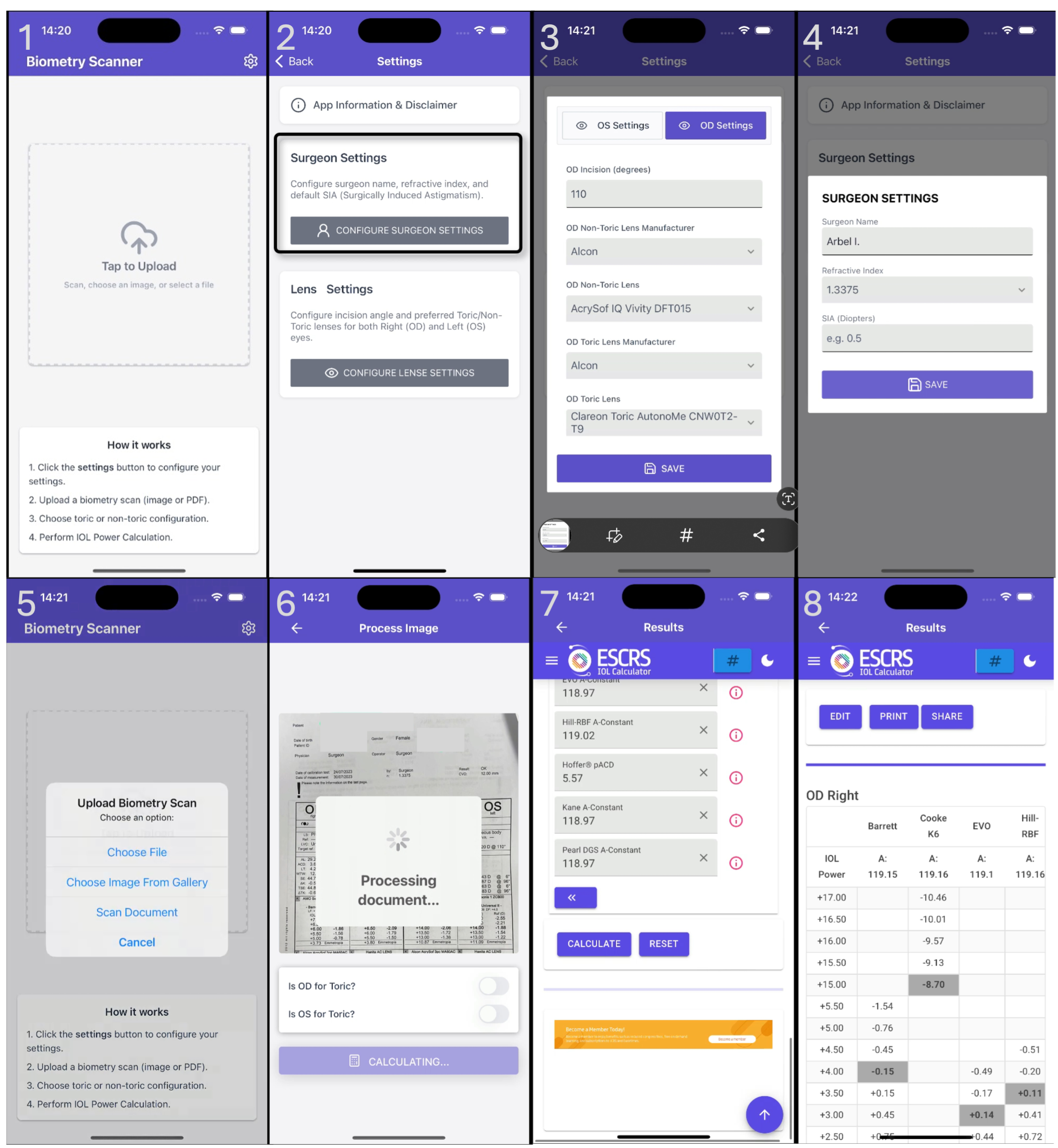
The Biometry Scanner App (OcuMetric Innovations LTD), available for iOS and Android, uses advanced optical character recognition (OCR) technology to streamline the process. It’s simple to use: open the app, scan the biometry printout with a smartphone camera or upload a photo or PDF file, and the app will automatically extract the numerical data to fill in the ESCRS IOL Calculator fields, saving time and effort.
The app allows users to save data entry points, including a default surgeon name, surgical induced astigmatism, incision location, and IOL model. It works with printouts from any biometric device and can process reports in multiple languages, recognising data regardless of the text labels used.
Proven efficiency and accuracy
A study recently validated the app’s performance by directly comparing it with manual data entry. The results highlighted significant efficiency gains, as the app reduced the average data entry time by 50%.
In a pilot survey of ophthalmologists, the app received a mean rating score of 4.5/5 for both ‘ease of use’ and ‘accuracy of data extraction.’ The app not only speeds up the process but also reduces the mental load on the clinical team.
As high-volume cataract clinics look to optimise every minute of the surgical day, the Biometry Scanner App offers a ‘low-hanging fruit’ solution. By eliminating manual transcription, it enhances safety by reducing error risk and significantly improves workflow efficiency. The app effectively bridges the gap between analogue printouts and digital calculation tools, allowing surgeons to focus less on data entry and more on surgical planning.
The Biometry Scanner App is available now.
Visit www.biometryscanner.com.
This article was prepared by Issac Levy, Mayank A Nanavaty, H Burkhard Dick, and Arbel Israeli, who participated in the development of the app.
Issac Levy MD is one of the founding partners of OcuMetric Innovations and is currently a cornea Fellow at Sussex Eye Hospital, Brighton, UK. drlevy.eye@gmail.com
Mayank Nanavaty MBBS, DO, FRCOphth, PhD is a cornea consultant based at Sussex Eye Hospital, University Hospitals Sussex NHS Foundation Trust, Brighton, UK. mayank.nanavaty@nhs.net
H Burkhard Dick MD, PhD is professor, chairman, and director at Ruhr University Eye Hospital, Bochum, Germany. He is president of the ESCRS. burkhard.dick@kk-bochum.de