Glaucoma
PMLT: A New Frontier for Ocular Hypertension
A new laser procedure with the potential to complement or surpass SLT.

Timothy Norris
Published: Friday, May 1, 2026
For the first time, Pattern MicroSecond Laser Trabeculoplasty (PMLT) has been performed in Europe. Davide Borroni MD of the University of Riga performed the procedure. An evolution of Micropulse Laser Trabeculoplasty (MLT), PMLT is designed to lower intraocular pressure (IOP) with an even gentler impact on ocular tissues. Both treatments are effective for open-angle glaucoma and aim to reduce IOP by acting on the trabecular meshwork.
The two techniques differ substantially in their mode of energy delivery, Dr Borroni observed. As the current first-line laser treatment, selective laser trabeculoplasty (SLT) uses short, high-energy pulses of about 1 mJ that selectively target pigmented trabecular cells. In contrast, MLT delivers energy through rapid, low intensity ‘micropulses’ separated by cooling intervals, allowing treatment of the trabecular meshwork without causing visible tissue damage. 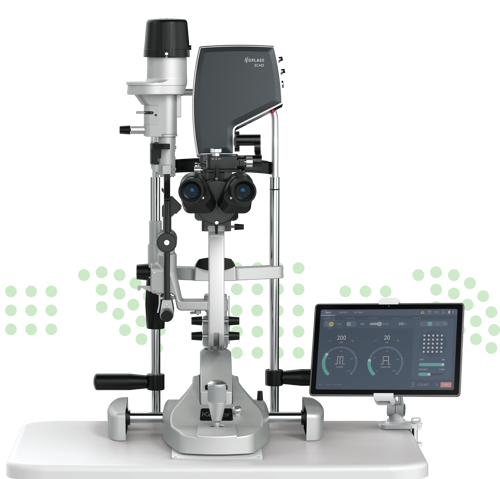
“Clinical outcomes are generally comparable in terms of IOP reduction, but MLT is typically associated with less post-treatment inflammation and represents a significant step forward in laser therapy for glaucoma,” he said in an interview with EuroTimes.
PMLT, developed by the Danish company Norlase, represents an evolution of MLT technology. It is designed to offer greater precision and improved control of energy delivery while maintaining the same tissue-sparing, subthreshold treatment profile, the company says. PMLT allows surgeons to align the laser spots along the natural curvature of the trabecular meshwork thanks to a digital pattern alignment system.
The microsecond-pulsing laser system was initially developed for macular oedema, achieving results comparable to those of yellow laser technology. Because of its efficiency and portability, the developers went on to adapt it for microsecond MLT. According to Dr Borroni, what makes this platform especially valuable is its high level of automation and digital guidance, which streamline the procedure and optimise spot alignment, significantly reducing execution time while maintaining precision and safety.
PMLT is essentially an evolution of MLT, Dr Borroni explained, as it allows for digitally controlled orientation of laser spots in sequences of four. This means PMLT can automatically deliver four consecutive pulses to the trabecular meshwork. With the MEMS technology built into the device, it is also possible to create a sequencing pattern that enables automatic alignment, ensuring no untreated areas or overlapping spots. All of this greatly simplifies the procedure and significantly reduces treatment time, he said.
Dr Borroni’s decision to test PMLT first in Europe stemmed from his need to find a valid alternative to existing pharmacological and surgical options.
“The idea was to address a common clinical need among my patients with ocular hypertension, aiming to manage it better while reducing the use of eye drops, prompting research for a ‘micropulsed’ solution,” he explained.
Dr Borroni performed the first laser trabeculoplasty with this device in Gallarate, in Lombardy, Italy. The patient had ocular hypertension and was using a hypotensive eye drop in the evening, which had caused dry and inflamed eyes as a side effect. After undergoing PMLT, the patient no longer needed the hypotensive drops. With the cessation of the medication, ocular inflammation resolved, and the patient’s symptoms improved, he said.
The procedure is performed in office and takes about three minutes per eye, using one drop of 1% pilocarpine. It is virtually painless, Dr Borroni noted. He used the Latina gonio lens from Ocular Instruments. One-month follow-up data showed an IOP reduction of about 18%.
In the meantime, he reported that 10 patients have already been treated with this device, adding that the follow-up results should be available shortly.
Patient selection must still be cautious, as with SLT, Dr Borroni stressed. He selected patients with ocular hypertension who were initiating IOP-lowering therapy, as well as those requiring an additional pharmacologic agent to achieve target pressure control.
“This procedure already has everything it needs to become the next first-line standard treatment,” Dr Borroni concluded.
Davide Borroni MD is a corneal surgeon and consultant at the University of Riga, Latvia.