Meetings, Cataract, Congress News, Society News, Research, Inside ESCRS
Four Competitors Enter, One Competitor Emerges
Four mentor-supported Innovators Den finalists pitched their ideas in hope of taking the top prize.

“ So we asked, ‘What if the two lenses could communicate, and worked as one, instead of as separate lenses? “
The Innovators Den, a popular feature of the iNovation Symposium, gives aspiring inventors and entrepreneurs a platform to introduce devices before a panel of judges. The London event saw the four finalists, each supported by an assigned mentor, present their ideas in a competitive round of pitches.
“The purpose of the Innovators Den is simple: it is to shorten the distance between a good idea and a real innovation in ophthalmology,” said Burkhard Dick, president of the ESCRS. “Many clinicians are aware of unmet needs, but the difficult part is turning the idea into a prototype, doing early-stage studies, and eventually offering a viable product. The Innovators Den helps to bridge the gap by providing mentorship, business guidance, and networking to each participant.”
Professor Dick sat on the judges panel with Rebecca Emerson, ESCRS Trustee and Independent Director and Risk Committee Chair, JP Morgan Markets; Diana Saraceni, Founder and Managing Partner, Panakès Venture Capital Firm; and Prof Susana Marcos, Director of the Center for Visual Science, University of Rochester, US.
The judges considered the magnitude of the problem being addressed, the degree of innovation, market strategy, potential for reimbursement, competitive analysis, and the quality and energy of the presentation.
“It is more than a competition,” Prof Dick said. “It is about giving promising ideas a better chance to become real.”
Amit Mishra, Kausprat LLP, who worked with mentor Jorge Alió MD, described a novel premium IOL design that allows multiple adjustments after implantation. The modifications are made with a wand that uses non-metallic spokes contained in the IOL. Adjustments can be made for hyperopia, myopia, and astigmatism. Unlike the current light-adjustable lens, this IOL would allow multiple follow-up refinements, he reported.
Simon Skalicky MD, Eyeonic company, worked with mentor Pablo Artal PhD. He described an AI-powered, cloud-based visual field testing platform. The software solution allows any computer or tablet to be used as a clinical-grade perimeter. It has been clinically validated and is now in use in Australia and elsewhere. The software uses advanced psychophysics and AI-driven algorithms to analyse patient responses. Each test takes two to five minutes.
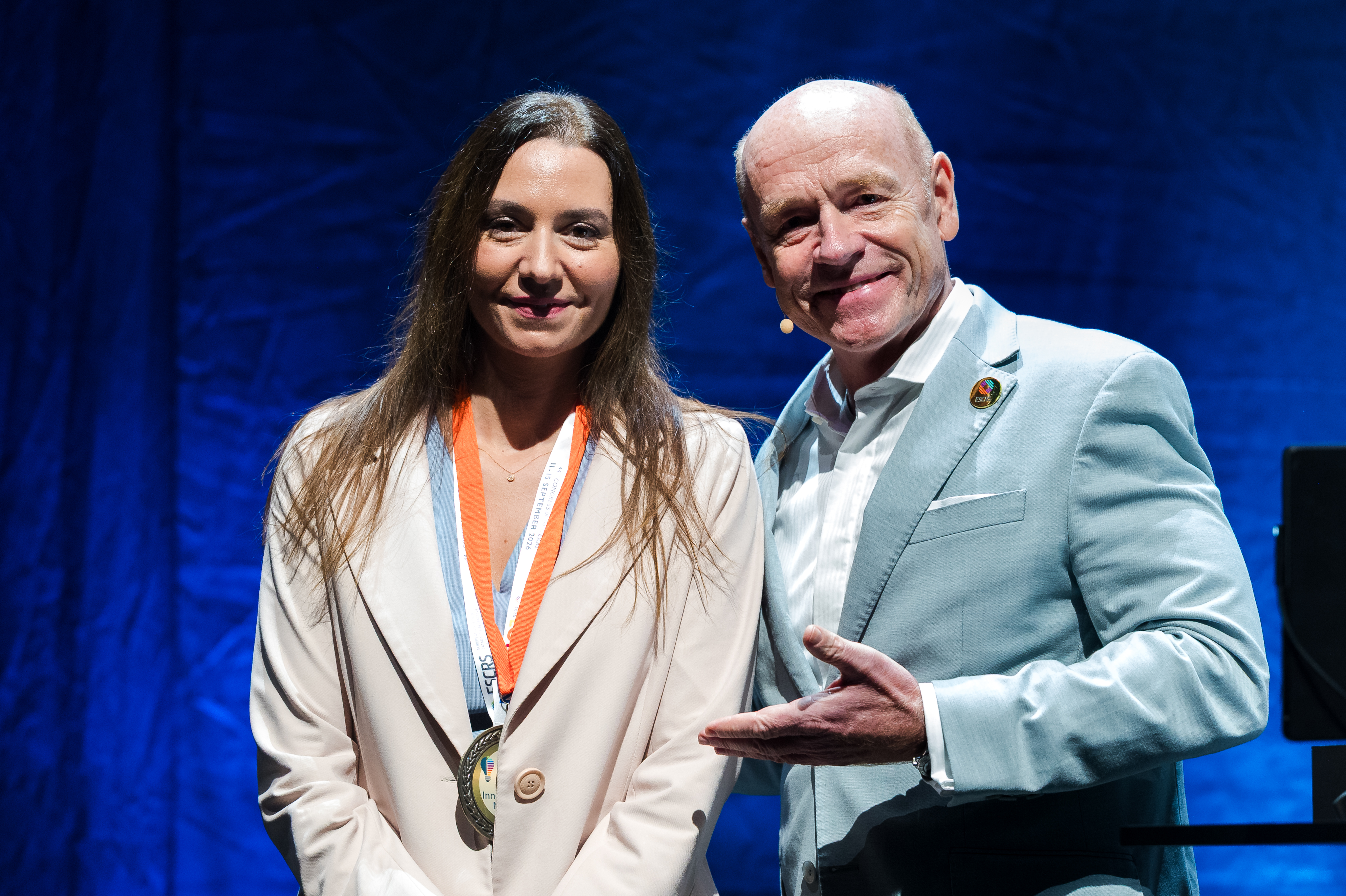
Maria Zozolou MD, PhD, Athens Vision Eye Institute, worked with mentor Rudy Nuijts MD, PhD on a binocular adaptive system of IOLs that communicate with each other to create accommodation.
“It is a different way of thinking about accommodation after cataract surgery,” Dr Zozolou said. “Accommodation is not just about the lens—it depends on the binocular system. So we asked, ‘What if the two lenses could communicate, and worked as one, instead of as separate lenses?”
Each lens contains a microchip with magnetic nanoparticles and a closed conductive loop. An electrical control signal can change the optical power of the lens. In another approach, the control signal activates a small actuator that changes the shape of the lens.
Finally, Edoardo Grosso MD worked with mentor Michael Mrochen MD on the Glauco Releaser, a minimally invasive, valveless nitinol filtering device designed to provide stable, long-term outflow for patients with primary open-angle glaucoma. The system is free from needling or revision and designed to prevent fibrosis, occlusion, and erosion.
The judges conferred and ultimately awarded the first prize to Dr Zozolou for her innovative approach to developing an accommodative IOL.