Meetings, Congress News, Global Ophthalmology, Society News, Inside ESCRS
ESCRS Honors Two for Service to Society
Two recognised for significant contributions to global eye care.

“ We exist to advance education, research, and, above all, better care for patients. “
Burkhard Dick MD, PhD, president of the ESCRS, announced the recipients of the inaugural ESCRS Humanitarian Service Awards during the opening ceremony of the Annual Congress. The two recipients later received special trophies at a formal ceremony.
Carlos Luis Moser Würth MD received the ESCRS Humanitarian Service Award, which is presented to an individual whose work has made a significant and lasting humanitarian impact through the delivery, development, or support of eye care services.
Esther Ciancas MD received the ESCRS David Chang Humanitarian Award, presented in recognition of outstanding service and commitment to humanitarian ophthalmology, acknowledging individuals who have demonstrated exceptional dedication to improving access to eye care and supporting underserved communities.
“Let me underline something that is sometimes forgotten: ESCRS is a charitable, entirely not-for-profit organisation. We do not exist to generate profit. We exist to advance education, research, and, above all, better care for patients. Humanitarian work is therefore not an activity at the edge of our Society; it belongs at its very heart,” Professor Dick emphasised.
Through its charitable programmes and partnerships, ESCRS supports sight-restoring surgery, community outreach, local team education, essential equipment, and the development of sustainable eye care services. The aim is not simply to arrive, operate, and leave, but to build local knowledge, infrastructure, and confidence that remain long after a visiting team has departed, he said.
Esther Ciancas MD
Dr Ciancas’ humanitarian work centres on the Turkana Eye Project, which she founded in 2003 with Drs Ana Sendagorta and Blanca García Sandoval. It began in Turkana, Kenya, a vast, remote region with a largely rural and nomadic population and, at the time, virtually no access to specialist ophthalmic care.
Although the project has now endured for more than two decades, its model was built through focused, high-impact deployments—each designed not only to treat patients but also to leave behind a stronger local service. 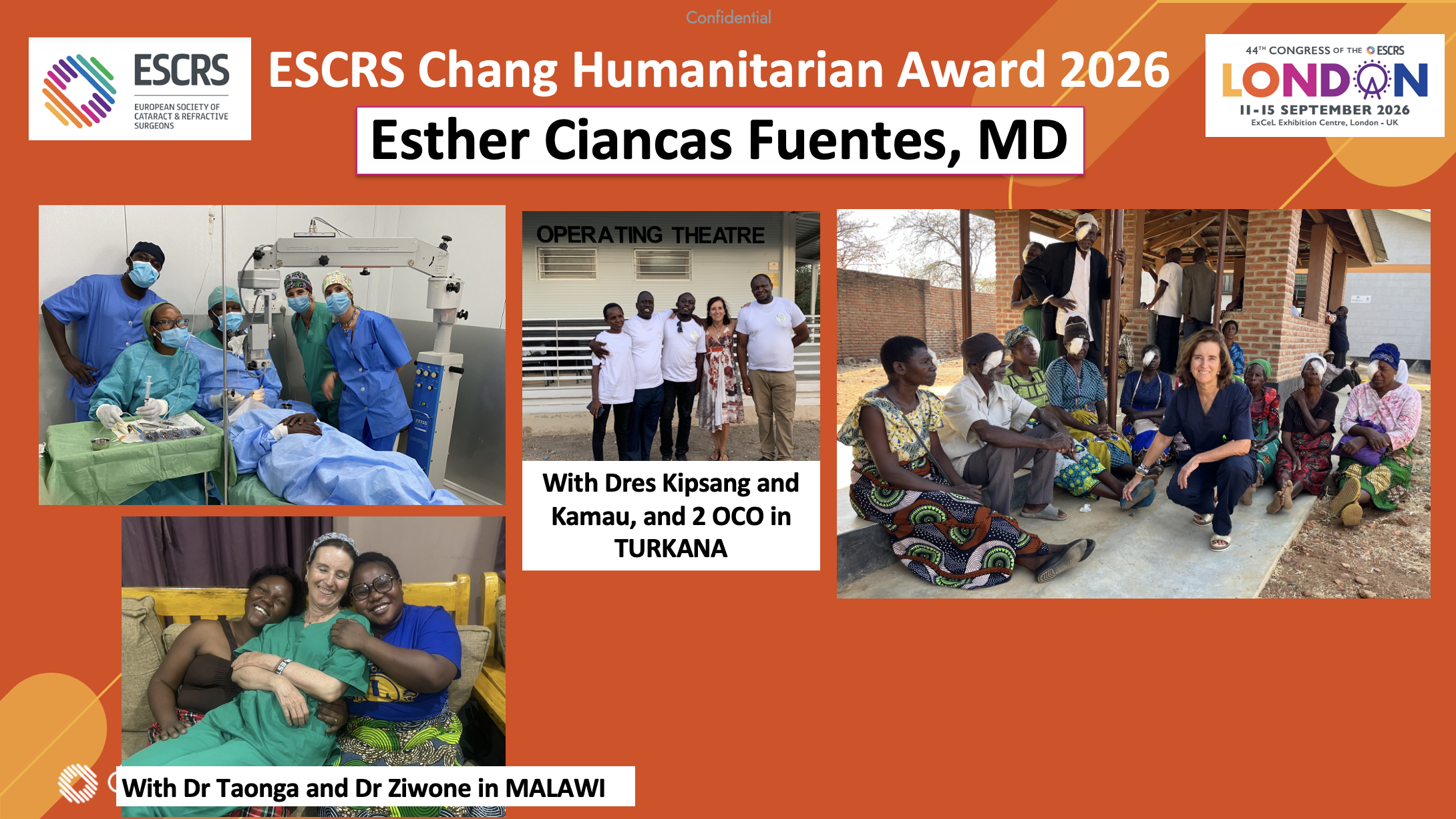
The early missions delivered comprehensive examinations, cataract surgery, refractive services, and treatment for ocular disease. But Dr Ciancas and her colleagues soon understood that even the most successful surgical campaign would never be enough on its own.
The real goal had to be a functioning local eye care system.
The project helped establish the Eye Unit in Lodwar—which has a consultation facility and operating theatre—and later supported the development of an operating theatre in Lokitaung, in northern Turkana. It invested not only in instruments and buildings but in people. More than 60 local healthcare professionals have been trained and integrated into continuing care, including ophthalmic assistants, nurses, and ophthalmologists. Three ophthalmologists have been trained, two of whom now work in Turkana, while Malawi is supporting further ophthalmology and optometry training.
The reported clinical impact is remarkable: thousands of consultations, more than 10,000 cataract operations across the project, many additional trachoma procedures, and thousands of pairs of spectacles.
Carlos Luis Moser Würth MD
Dr Moser Würth has devoted more than four decades to clinical ophthalmology, education, and humanitarian service.
His connection with global health began in 1984, when he joined a medical cooperation programme in Mozambique as a clinician and teacher. Since 2002, he has been deeply involved with Fundación Ulls del Món (Eyes of the World) and has helped lead and supervise ophthalmic programmes in Mozambique, particularly in Maputo and Inhambane Province.
His humanitarian work has also taken him repeatedly to Ethiopia, including Mekele and Adigrat; South Sudan; the Sahrawi refugee camps; and Bolivia. These settings are shaped by poverty, distance, fragile infrastructure, displacement, and, in some cases, conflict. 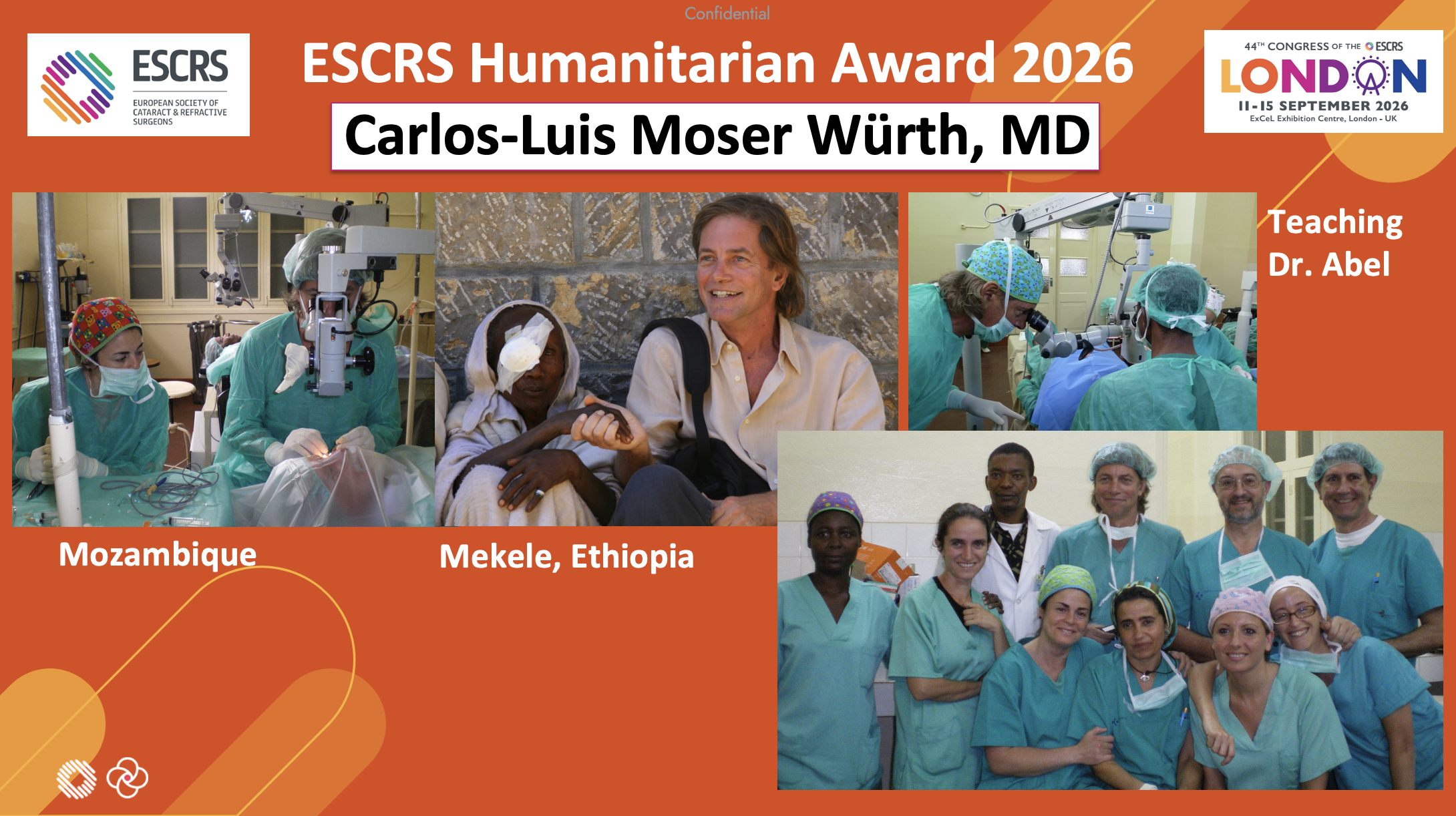
His distinctive contribution has been combining surgery with teaching, quality assurance, public health planning, and institutional development.
His documented direct activity includes around 6,000 examinations and 2,880 operations. He has been a committed teacher of small incision cataract surgery (SICS0, a safe and cost-effective technique particularly suited to low-resource environments.
Through 15 structured SICS courses, Dr Moser Würth trained 210 ophthalmologists, many of whom later applied these skills during humanitarian work before passing them on to others. In this way, one teacher has enabled many more surgeons to restore sight far beyond the places he could reach personally.
In Mozambique, he has mentored ophthalmologists, ophthalmic medical assistants, technicians, and optometrists. He has helped standardise preoperative, intraoperative, sterilisation, antibiotic, and follow-up protocols; supported preventive equipment maintenance systems; introduced structured outcome monitoring through BOOST (Better Operative Outcomes Software Tool) cataract; contributed to national eye health planning; and helped design safer, more efficient facilities and referral pathways.
The wider Inhambane programme under his medical supervision illustrates the scale of this legacy. Since 2002, it has reported more than 363,000 consultations and refractions, almost 14,000 surgical interventions, and more than 1,800 professionals trained.
These are programme-wide achievements, built by many hands; but Dr Moser Würth has been one of the people ensuring that those hands become more skilled, the systems more reliable, and the results more sustainable.
His philosophy is simple but profound: restore sight today, while building the capacity to deliver better care tomorrow.