Meetings, Glaucoma
Does GAT Belong in a Museum?

Timothy Norris
Published: Friday, October 2, 2026
Should Goldmann Applanation Tonometry (GAT) be ditched? According to Professor Anthony Khawaja, the answer is definitely yes.
“If we were to step outside of ophthalmology and ask medical colleagues which one of all of these devices is the best way of measuring pressure in the eye, I don’t think any of them would say this tin can,” Prof Khawaja joked. As a matter of fact, the majority of ophthalmologists still rely heavily on GAT to measure intraocular pressure.
Considered for many years (and still today) as the gold standard, GAT used to be considered more accurate than standard air-puff tonometry, especially when dealing with thicker corneas. For Prof Khawaja, however, many are the shortcomings of a device that is showing its age. Due to the need for mydriatic eye drops and disposable prisms, GAT is not environmentally sustainable. Additionally, it is very sensitive to corneal artefacts and not as user friendly as more modern devices. GAT is not only quite unreliable, it provides worse results when used by a technician, he said. Underlining that this is one kind of examination that should be delegated, he noted that not using technicians slows down the workflow and creates avoidable waiting queues. 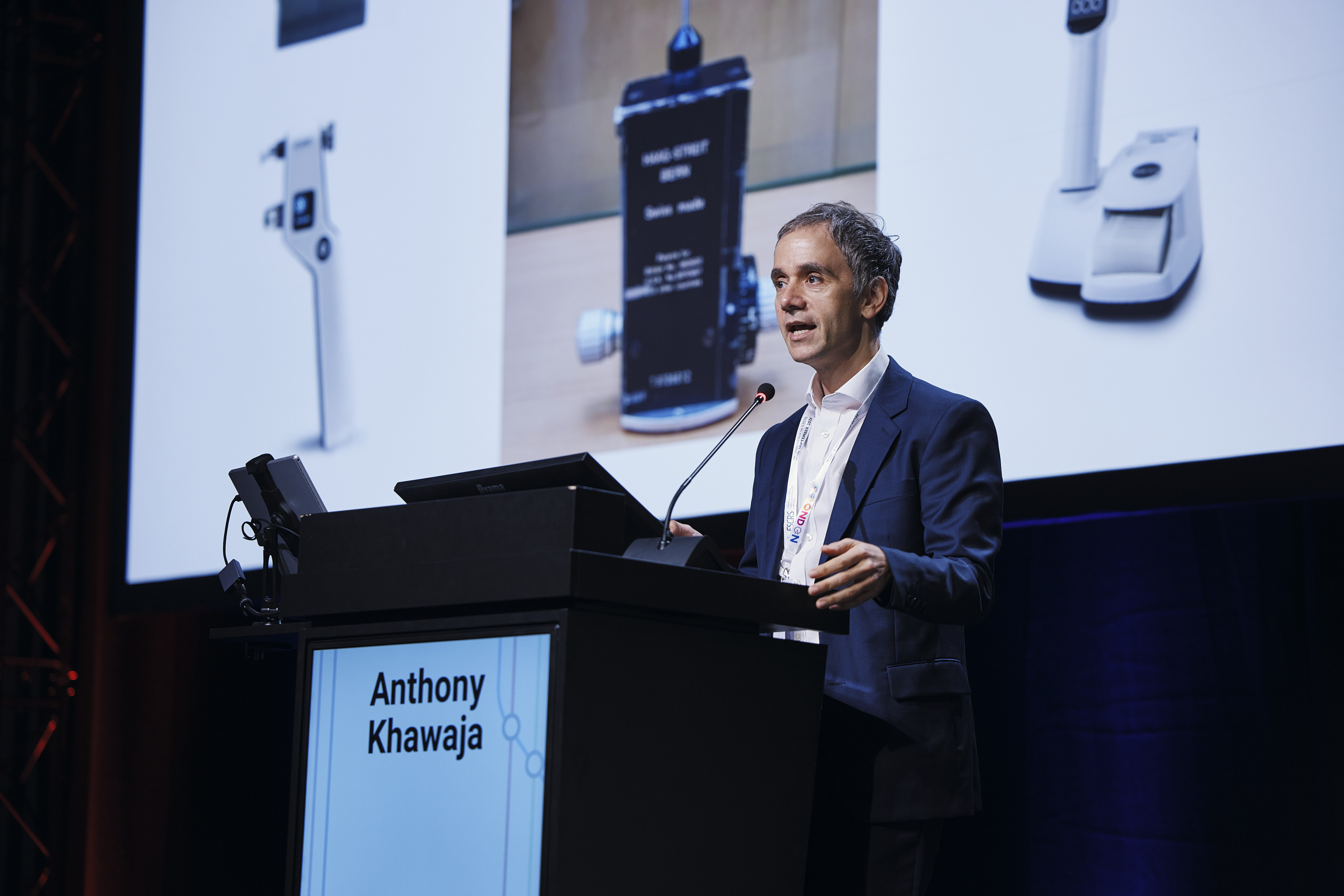
Based on his experience at Moorfields, Prof Khawaja underlined how the long-term costs of a more modern device are sensibly lower than using a Goldmann’s. Cost is very important, he said. In the short term, a device like the Corvis ST or the Optical Response Analyzer is surely more expensive; however, they eventually save money thanks to the lack of disposable parts. Based on treating 100 patients a week, it is possible to save up to £50,000 in 10 years and £100,000 if you have 300 patients a week and an optical response analyser rather than a GAT. Not counting the use of fluorescein, anaesthetic and risk of infection are all things that make Goldmann’s more expensive, he added. GAT also requires a slit lamp, which a staff member must ensure is calibrated correctly, requiring added training and staff time.
The biggest elephant in the room, however, is the cornea. It is known that central corneal thickness is just a geometric parameter, not a dynamic parameter. It is important to have a tonometry that better accounts for this. “And we have them,” Prof Khawaja said.
At Moorfields Eye Hospital several years ago, Prof Khawaja and his team changed the default tonometry to the corneal-compensated value from the Ocular Response Analyzer, and they haven’t looked back. So, why is ophthalmology not moving on from GAT?
“I think this is a dogma,” Prof Khawaja said. “I think when you first start ophthalmology, you are told this is the reference standard, and you don’t hold a challenge in it.”
Prof Khawaja is said to be a massive fan of the late Hans Goldmann himself, though he recognises that the technology invented by the Swiss-Austrian ophthalmologist is 70 years old today.
“I think it’s time this rusty old tin can is banished to the Museum of Eye Instruments. That can be a redemption,” Prof Khawaja concluded.
Anthony Khawaja, MD, PhD, is Professor of Ophthalmology and Honorary Consultant Ophthalmic Surgeon at the University College London, Institute of Ophthalmology and Moorfields Eye Hospital. anthony.khawaja@ucl.ac.uk