Artificial Intelligence, Global Ophthalmology, Practice Development, Digital Health
Optimizing Innovation Through AI Collaboration
Leveraging design thinking and prompt selection to enhance AI-generated solutions.


Cheryl Guttman Krader
Published: Sunday, March 1, 2026
“ Using AI prototyping, ophthalmologists could visualize changes in clinic layout to enable improved patient flow, while the persona pattern allows ophthalmologists or their staff to appreciate how insurance claims representatives might respond to a payor’s complaint. “
Co-creating ideas by integrating artificial intelligence (AI) with design thinking can accelerate the capacity to innovate, but getting optimal value out of this interaction depends on the effectiveness of user prompts.
“If you simply ask AI for ways to motivate ophthalmologists for grassroots advocacy, you will get generic answers,” data scientist Michael Levitt said to illustrate this point. “However, pairing specialized AI prompt patterns with design thinking can create a problem-solving framework that sparks AI to supply tailored ideas.”
He provided an in-depth discussion of integrating the design thinking process and specialized prompt patterns to enlist AI’s assistance with the above query. Mr Levitt also offered ideas of how ophthalmologists could use the specialized AI prompt patterns to brainstorm for help preparing for a job interview or addressing various practice management issues.
Mr Levitt explained that design thinking consists of a series of steps, each with a distinct purpose and subject to different AI prompt patterns. ‘Empathize’, the first step in the process, seeks to understand the user’s need. ‘Define’ comes next and serves to craft a problem statement, followed by ‘ideate’ where ideas are generated. The ideas are then refined and improved in the ‘iterate’ step and subsequently (or simultaneously) assessed in the ‘evaluate’ step. Next comes ‘prototyping’, where models or representations are created, and finally the feedback-gathering ‘validate’ step.
Showcasing AI prompt patterns that can be used in these steps, Mr Levitt said that a ReAct (Reason and Act) loop pattern in the empathize step will prompt AI to conduct an open-ended interview. After the user inputs a thought, AI searches for key points, themes, and/or gaps and reacts with clarifications, reflections, and/or questions.
“Based on what it learns, AI adapts follow-up questions for deeper insights,” Mr Levitt said.
A flipped interaction pattern can be applied in the define step, in which the human co-creator prompts AI to ask context-building questions. In the ideate step, a persona pattern is applied to create an ideation team and shape the tone, style, and output from AI. Each persona brings a different perspective by virtue of having unique traits, motivations, and approaches, and the team works with AI in a round-robin exercise where each participant seeds an idea and the others build on it sequentially using a chain-of-thought prompt pattern.
The iterate and evaluate steps work in tandem, Mr Levitt said, and are implemented with a tree-of-thought pattern where the user prompts AI to branch and compare multiple reasoning paths. As it evaluates the various ideas, AI selects the most promising one(s), generates new iterations, and then evaluates and selects the best options until the co-creator selects the ‘winner’.
“AI can be prompted for ways to improve prompts at each node of the branch and compare process, and this can sharpen the output from the iteration and evaluation steps,” he said. “In the iterate and evaluate steps, AI can also describe the potential weaknesses of the generated variants and develop targeted solutions.”
In the prototype step, AI can be asked to generate visual models in the aptly named ‘AI Generated images’ prompt pattern. The AI-created conceptualizations emphasize key interactions, processes, user journeys, and system cohesion using the most suitable visualization method. 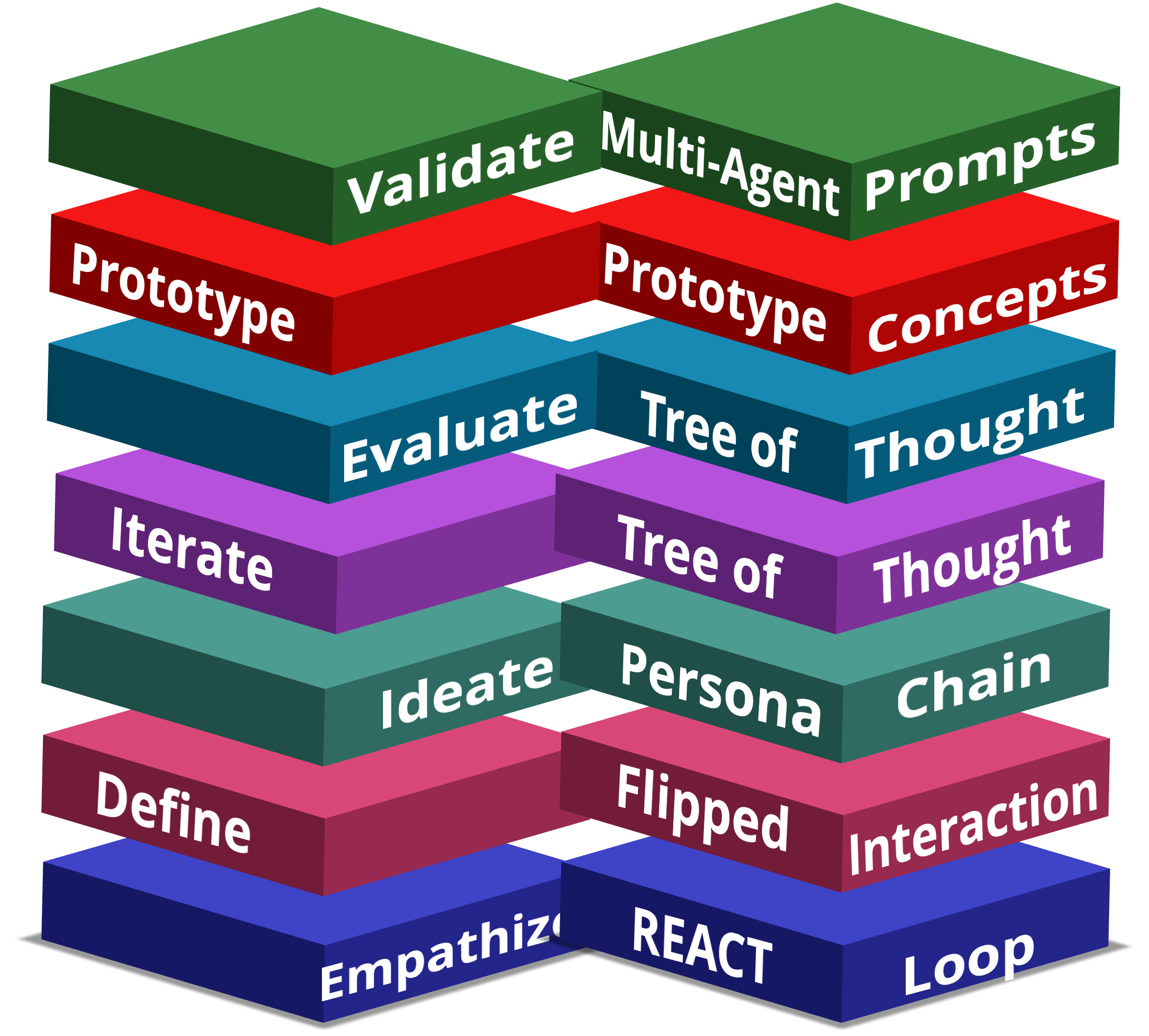
Finally, the multi-agent prompting pattern is applied in the validation step: the co-creator’s prompt asks AI to run a focus group to gather feedback on an idea in a simulated structured discussion among AI agents representing key stakeholders.
More real-world examples
Discussing other areas where ophthalmologists could use the AI prompt patterns, Mr Levitt noted that the ReAct Loop pattern could be applied when turning to AI for help in preparing for a job interview, while the chain-of-thought pattern could be helpful for drafting step-by-step training modules for office hires.
He also suggested that ophthalmologists seeking AI-generated ideas for easing clinic bottlenecks could use the flipped interaction pattern to help define the existing problems, or the tree-of-thought pattern to assess trade-offs in choosing different clinical scheduling plans, such as for comparing a shift to lengthening visit time slots, introducing double-booking, or initiating weekend clinics. Using AI prototyping, ophthalmologists could visualize changes in clinic layout to enable improved patient flow, while the persona pattern allows ophthalmologists or their staff to appreciate how insurance claims representatives might respond to a payor’s complaint.
As another suggestion, Mr Levitt proposed using the multi-agent prompt to gain insights into the pros and cons of moving forward with a significant capital investment, such as acquiring a new femtosecond or excimer laser. In this exercise, the agents could include the practice’s operations manager, finance officer, compliance agent, strategic analyst, and patient experience representative.
Mr Levitt spoke on this topic at AAO 2025 in Orlando, US.
Michael Levitt is Head of Data Analytics for State and Federal Affairs at the American Academy of Ophthalmology. mlevitt@aao.org